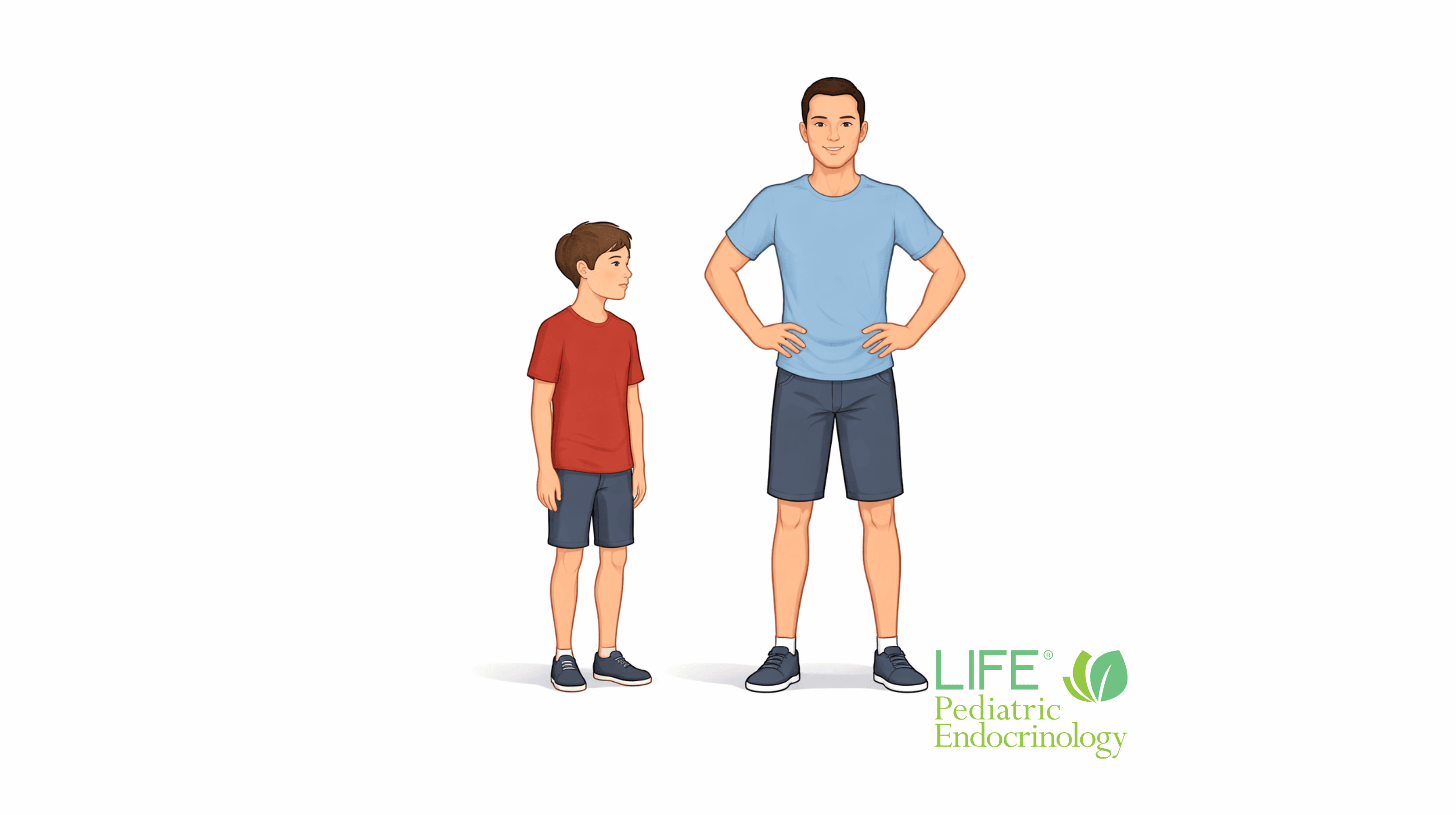
What a Delayed Bone Age at 13 Means for Puberty and Final Height
Written and reviewed by Dr. Kelli Davis
Board-Certified Pediatric Endocrinologist
Life Pediatric Endocrinology
If your son is 13 and you were told his bone age is delayed, you may be concerned.
Is puberty late?
Is something wrong hormonally?
Will he be shorter than expected?
Here is the most important reassurance first:
A delayed bone age at 13 in boys is often normal.
In fact, it can sometimes be a sign that more growth time remains.
The key is understanding the difference between normal variation and true hormone deficiency.
What Does Bone Age Delayed at 13 in Boys Mean?
Bone age reflects skeletal maturity.
If your 13 year old son has a bone age of 11, that means his bones are developing more slowly than his chronological age.
This typically indicates one of two possibilities:
- Constitutional delay of growth and puberty
- An underlying hormonal issue
Most commonly, it is constitutional delay.
What Is Constitutional Delay of Growth and Puberty?
Constitutional delay is a normal developmental pattern.
These boys are often described as:
- Late bloomers
- Smaller than peers in middle school
- Slower to enter puberty
Puberty in boys normally begins between ages 9 and 14.
If a 13 year old has not progressed much in puberty and bone age is delayed, he may simply be on a slower timeline.
Here is an important concept:
Delayed bone age often means delayed growth plate closure.
That can mean:
More time left to grow.
When Is Delayed Bone Age Reassuring?
It is usually reassuring when:
- Growth velocity is steady
- There is family history of late puberty
- Predicted adult height matches genetic target
- Testicular volume is starting to increase slowly
A delayed bone age in this context suggests future catch up growth.
Many of these boys ultimately reach normal adult height.
When Should We Be Concerned?
Evaluation becomes more important if:
- Growth velocity is very slow
- There are no pubertal signs by 14
- Predicted adult height is falling below genetic expectation
- There are symptoms of other hormonal problems
Although true growth hormone deficiency is rare, it must be considered when growth rate is inadequate.
Slow bone age alone is not the problem. Poor growth velocity is the bigger red flag.
How Pediatric Endocrinologists Evaluate a 13 Year Old Boy with Delayed Bone Age
A careful evaluation includes:
- Growth chart review over several years
- Calculation of growth velocity
- Tanner staging
- Testicular volume measurement
- Predicted adult height assessment
- Selective hormone testing when indicated
The most important data point is not the X ray.
It is the growth pattern.
Trend over time matters more than a single measurement.
Does Delayed Bone Age Mean He Will Be Short?
Often, no.
In constitutional delay:
- Puberty starts later
- Growth spurt happens later
- Growth plates close later
That can allow for extended growth.
However, if growth velocity is insufficient, adult height may be compromised.
The distinction requires proper evaluation.
Do Not Ignore Persistent Delay
Most boys with delayed bone age at 13 are late bloomers.
But not all.
Here is the uncomfortable truth:
If growth velocity is slowing and puberty is not progressing, waiting can limit future options.
Growth plates do not stay open forever.
By age 15 or 16, the window for intervention begins narrowing.
If a boy truly has:
- Growth hormone deficiency
- Hypogonadism
- A treatable endocrine disorder
And evaluation is delayed, valuable growth time can be lost.
The earlier we identify a problem, the more flexibility we have.
The later we intervene, the fewer options remain.
That does not mean panic.
It means measure carefully instead of assuming.
Reassurance Is Appropriate When Data Supports It
There is a difference between:
“It is probably fine.”
and
“We have calculated predicted adult height, evaluated growth velocity, and confirmed this is constitutional delay.”
True reassurance comes from data.
Not assumptions.
If your son has bone age delayed at 13, ask these questions:
- What is his current growth velocity?
- What is his predicted adult height?
- How does that compare to mid parental height?
- What is his testicular volume?
- When should this be reassessed?
If those questions cannot be clearly answered, further evaluation is reasonable.
The Cost of Waiting
In pediatric endocrinology, timing matters.
Delayed puberty due to constitutional delay is common.
Delayed puberty due to hormone deficiency is rare.
But rare does not mean never.
Missing the window to intervene can mean permanently lower adult height.
Careful evaluation does not harm.
Unnecessary reassurance sometimes does.
Can Treatment Help?
In some cases, yes.
For boys with significant delay and psychosocial distress, there are medications that can be considered to help them.
In many cases, there are other medications to assist with family goals and values.
But most boys with delayed bone age at 13 simply need monitoring and reassurance.
Emotional Impact Matters
Thirteen is a vulnerable age.
Being smaller than peers can affect confidence, athletics, and social development.
While many boys catch up naturally, supportive guidance and monitoring provide clarity and peace of mind.
Frequently Asked Questions (FAQ)
Is 13 too late to start puberty in boys?
No. Puberty can begin anytime between 9 and 14.
Does delayed bone age mean delayed puberty?
Often yes. Bone maturity and pubertal timing are closely linked.
Will my son catch up in height?
Most boys with constitutional delay eventually catch up and reach normal adult height. However, this must be monitored closely, to ensure the family's goals and values are being met.
Are there medications to assist with the psycho-social implications?
Yes. There are several medications to assist kids and ensure the child meets their genetic potential.
Should we repeat the bone age study?
Yes. Monitoring progression over time can clarify trajectory.
Clarity Replaces Guesswork
If your son has bone age delayed at 13, the most important step is structured evaluation.
At Life Pediatric Endocrinology, our board certified pediatric endocrinologists provide detailed growth analysis, pubertal assessment, and individualized planning.
We serve families across the United States, with offices in Georgia, Tennessee, Texas, and California, and offer nationwide virtual consultations. Schedule a consultation to learn more about how LIFE can support your child through this season and ensure they do not "miss" their window.
When growth and puberty timing feel uncertain, data brings clarity.